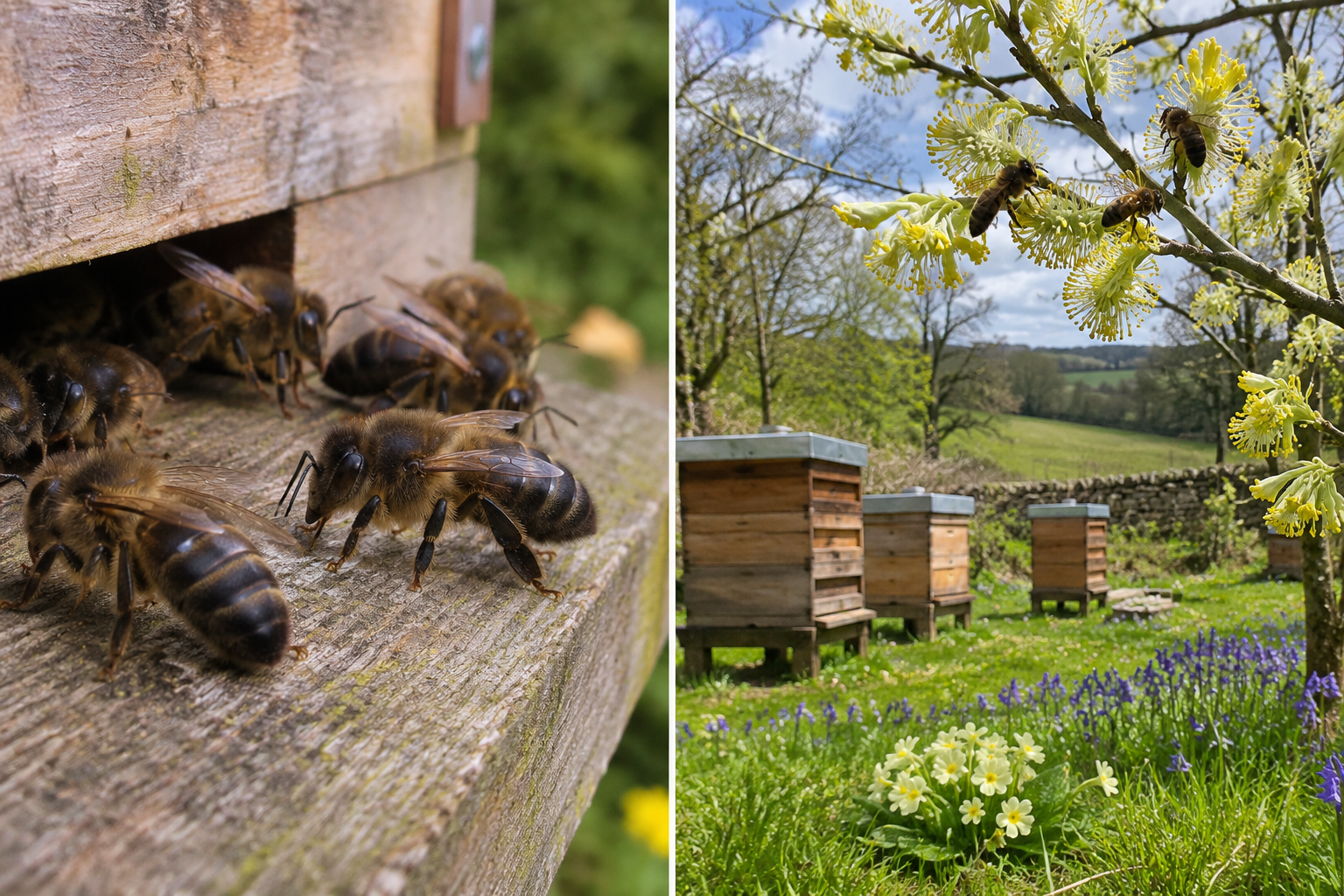
Locally adapted bees are not simply interchangeable colonies that can be moved from one environment to another and expected to perform equally well. Over generations, honey bee populations develop characteristics influenced by climate, forage availability, seasonal patterns, disease pressures and the environments in which they live.
For UK beekeepers, this raises an important question: are we giving enough consideration to the advantages of keeping and breeding bees that are adapted to the conditions in which we actually keep them?

The discussion surrounding locally adapted honey bees has become increasingly important. Across Britain, beekeepers are reassessing the value of imported queens, commercial breeding lines, regional populations and the conservation of our native honey bee, Apis mellifera mellifera, commonly known as the British Black Bee or European Dark Honey Bee.
Local adaptation is not about nostalgia or rejecting every non-native bee. It is about recognising that the environment plays a fundamental role in colony performance, survival and long-term sustainability.
Britain’s native honey bee
The European Dark Honey Bee, Apis mellifera mellifera, is the honey bee subspecies historically native to much of northern and western Europe, including Britain and Ireland. It belongs to the M evolutionary lineage and developed across a geographical range characterised by relatively cool climates, seasonal weather and variable forage availability.
The British Black Bee is often associated with a darker appearance, substantial body hair and a darker abdomen. However, appearance alone is not a reliable way of establishing genetic identity. Honey bees can exhibit considerable variation, and hybridisation over generations means that visual identification cannot establish whether a colony is genetically representative of the native subspecies.
Our climate presents a demanding combination of conditions: long periods of winter weather, unpredictable spring temperatures, rain and wind that interrupt foraging, variable nectar and pollen availability, short periods of intense forage followed by dearths, and substantial regional differences.
What does locally adapted actually mean?
A locally adapted bee is not necessarily a bee belonging to a recognised subspecies. Local adaptation refers to inherited characteristics that improve the ability of a population to perform and survive within particular environmental conditions. These characteristics may develop through natural selection, deliberate breeding or a combination of both.
A population can become adapted to local conditions without being genetically pure in the traditional subspecies sense. Bees kept and selected over many generations in northern England, for example, may gradually develop a population that performs consistently under the conditions encountered in that region. The population may contain contributions from different ancestral backgrounds and still demonstrate useful locally adapted characteristics.
Potentially relevant traits include seasonal brood production, winter survival, appropriate colony population growth, efficient use of stores, foraging behaviour during variable weather, timing of development, responses to local forage, disease and parasite resilience, swarming behaviour and temperament.
The British climate and the importance of adaptation
British beekeepers operate in a climate where weather can be unpredictable. A warm period in March may be followed by cold weather. Colonies can expand rapidly during favourable conditions only to encounter weeks of rain or low temperatures. Nectar flows can be short, and forage availability differs substantially between urban areas, farmland, heathland, woodland and coastal environments.
A colony that develops rapidly may be productive under favourable conditions. However, rapid development can also create additional demands on food supplies when weather or forage conditions deteriorate.
The ability to respond appropriately to changing conditions is potentially valuable. A colony that develops steadily, maintains adequate reserves and responds to genuine forage opportunities may prove more sustainable under a particular beekeeper’s conditions than a colony selected solely for maximum early-season population growth.
This does not mean slow development is always desirable, or that vigorous colonies are unsuitable for Britain. It means colony development should be evaluated in relation to the environment and the beekeeper’s objectives.

Winter survival and food efficiency
Winter survival is one of the most obvious characteristics that beekeepers can evaluate. A colony must maintain a viable population, conserve energy, manage food supplies and survive periods when flying and forage opportunities are limited.
Winter survival is influenced by colony population entering winter, queen quality and age, food stores and their accessibility, Varroa infestation and virus burden, disease, hive conditions, weather and management decisions.
Local adaptation may influence some of these characteristics, but survival cannot be attributed to genetics alone. A colony that survives a difficult winter may have benefited from excellent management, favourable hive positioning, sufficient stores or lower disease pressure.
Nevertheless, repeatedly observing colonies that survive and perform well under the same regional conditions provides valuable information. Over several years, a beekeeper can begin identifying colonies that consistently demonstrate desirable characteristics. This is far more useful than judging a colony on one exceptional season.
The importance of seasonal brood development
Brood development is another area where local adaptation and selection may have practical significance. Queen bees differ in their laying patterns, while colonies differ in how they regulate brood production and population growth.
The relationship between brood production, available food and weather is particularly important in the UK. Early brood expansion can be beneficial when spring arrives early and forage is plentiful. However, sustained brood production during poor weather can increase nutritional requirements.
Beekeepers should consider whether a colony’s seasonal development is appropriate for its local environment. The aim should not necessarily be to produce the largest possible colony as early as possible. Instead, the objective should be a colony that develops at an appropriate rate, maintains sufficient workers, takes advantage of available forage and enters winter in good condition.
Britain’s Black Bee and genetic conservation
The native Apis mellifera mellifera has experienced significant genetic mixing with other honey bee populations. For generations, queens and colonies have been moved between regions and countries. Imports of various subspecies and commercial breeding lines have contributed to hybridisation throughout much of Britain.
As a result, identifying genetically representative native populations has become an important conservation and research objective. The British Black Bee is not extinct. Research has identified populations and colonies with relatively low levels of introgression in particular areas of Britain and Ireland.
Genetic studies have highlighted geographic variation and the continued importance of investigating native populations and genetic resources. Conservation strategies need to be geographically appropriate. Protecting genetically representative populations may be particularly important in certain locations, while in much of Britain, improving regional bee populations through careful selection and avoiding unnecessary long-distance movement may offer a practical approach to maintaining adaptation.
The distinction matters. Conservation does not always require every beekeeper to pursue genetic purity. Regional improvement, responsible breeding and reducing unnecessary movement of queens may also contribute to maintaining valuable genetic diversity.
Why importing queens deserves consideration
Queen imports have long been part of modern beekeeping. Beekeepers may purchase queens for temperament, honey production, rapid development, availability or specific breeding characteristics.
There is nothing inherently wrong with selecting queens from outside one’s immediate region. However, the consequences of repeatedly introducing genetics from distant environments deserve consideration. Honey bee queens mate with multiple drones, and mating can take place over considerable distances relative to an apiary. When imported or non-local queens are introduced, their descendants may contribute genes to the surrounding population through mating and colony reproduction.
Repeated introductions can alter regional populations over time. This does not mean all imported bees are unsuitable. It means imports should be considered as a deliberate management and breeding decision rather than an automatic annual requirement.
Selecting bees for the conditions where they are kept
A practical approach to local adaptation is to select breeding colonies based on performance rather than appearance or origin alone. A beekeeper could establish a simple selection framework covering several important characteristics:
Winter survival
Record whether colonies survive winter and whether they require unusual intervention. Consider survival alongside disease management, food availability and colony strength.
Spring development
Observe how colonies develop following winter. Record whether they build appropriately for local spring conditions without becoming excessively dependent on feeding or exhausting reserves during poor weather.
Temperament
Temperament is an important practical consideration. Colonies that can be managed calmly and safely are suitable for many apiaries, particularly urban or suburban environments. Assess temperament consistently and over more than one inspection.
Swarming behaviour
Record swarm preparation, queen cells, swarm-control interventions and manageability. Swarming is natural reproductive behaviour, and no breeding programme should expect to eliminate it completely. Manageable swarming behaviour can nevertheless be a useful selection objective.
Honey production
Honey production remains important for many beekeepers. Evaluate it alongside colony survival, health, management requirements and forage availability. A colony that produces a large crop in one season but requires substantial intervention may not necessarily be the best breeding candidate.
Disease and Varroa management
Monitor colonies and treat when necessary. Breeding decisions can incorporate observations of hygienic behaviour, brood health, colony condition and other potentially useful resilience traits. Apparent resistance or tolerance should not be assumed without appropriate observation and testing. Routine Varroa management remains essential unless colonies are being assessed under a carefully designed programme with appropriate safeguards.
Consistency
Consistency is one of the most valuable selection criteria. A colony that demonstrates desirable characteristics over several seasons is a more meaningful breeding candidate than one that performs exceptionally well during a single year.
A practical regional breeding approach
Beekeepers do not need to operate a large breeding programme to begin improving their stock. A small, practical selection programme can be developed within an existing apiary.
Start by identifying colonies that consistently demonstrate good winter survival, appropriate spring development, manageable temperament, good brood quality, reasonable swarming behaviour, strong performance during local forage periods, manageable disease levels, appropriate food consumption and good overall colony condition.
Maintain records for each colony. When a colony demonstrates consistently desirable characteristics, it can become a candidate for queen rearing. Over time, queens raised from selected colonies can be used to develop a locally improved population.
However, queen mating remains a major limitation. Without controlled mating, a queen’s offspring will receive genetic contributions from drones in the surrounding area. Selection of the mother colony alone therefore does not guarantee that her daughters will reproduce the same characteristics.
Isolated mating areas, drone saturation, instrumental insemination and coordinated regional breeding programmes can improve control over mating, but these approaches vary considerably in complexity. For many ordinary beekeepers, the most realistic objective is gradual improvement rather than genetic control.
Avoiding genetic bottlenecks
Selecting the best colony and repeatedly breeding only from that colony can create problems. Honey bees require sufficient genetic diversity for healthy colony populations. Excessive concentration on a narrow group of breeding queens can increase the risk of inbreeding and reduce genetic diversity.
A sustainable selection programme should therefore consider multiple good colonies rather than a single favourite. Selection should balance performance with genetic diversity. Beekeepers should avoid creating a population that becomes excessively narrow genetically simply because a few colonies demonstrate particularly desirable characteristics.
Regional cooperation can help. Sharing breeding information, maintaining several useful breeding lines and avoiding excessive reliance on a single queen source can support a more sustainable approach.
Local adaptation does not mean every bee should be dark
One of the most common misunderstandings surrounding the British Black Bee is that colour can establish whether a bee is native or locally adapted. It cannot.
Honey bee colour is influenced by genetics, and visual characteristics can vary within populations and between hybrid combinations. A dark colony may contain substantial genetic contributions from other subspecies. A colony that does not appear particularly dark may still possess useful regional adaptations.
Visual identification has its place, but genetic assessment is required when establishing subspecies identity with confidence. For ordinary beekeeping, performance under local conditions may be more relevant than colour alone. For conservation programmes specifically focused on Apis mellifera mellifera, genetic testing and appropriate breeding controls are considerably more important.
Sustainable beekeeping begins with observation
The concept of locally adapted bees fits naturally into a sustainable approach to beekeeping. Rather than continually replacing colonies with new stock, beekeepers can learn from their own apiaries. For further practical resources, visit The Busy Bee Emporium.
Which colonies survive? Which develop at the right time? Which maintain healthy brood? Which manage their stores sensibly? Which require the least unnecessary intervention while still receiving appropriate care? Which produce useful honey crops under local conditions?
These questions encourage a long-term approach to colony management. Sustainability does not mean abandoning treatment, accepting poor colony performance or allowing colonies to struggle unnecessarily. It means combining sound husbandry, responsible disease management, careful breeding decisions, appropriate forage provision and a willingness to learn from the colonies themselves.
The future of Britain’s honey bees
Britain’s honey bee population is genetically diverse and geographically variable. The native British Black Bee remains an important part of our natural and beekeeping heritage, but the wider question of local adaptation extends beyond subspecies conservation.
Beekeepers across Britain can contribute to healthier regional populations by making thoughtful breeding decisions, recording colony performance, avoiding unnecessary movement of queens and supporting genetic diversity.
The future may not depend on every beekeeper maintaining genetically pure Apis mellifera mellifera. It may depend on more beekeepers recognising the value of bees that are well suited to the environments in which they are kept, and making selection decisions based on long-term performance rather than short-term convenience.
Local adaptation is not a finished product. It is an ongoing process shaped by the environment, genetics, management and the choices we make as beekeepers.
The most sustainable bees may ultimately be those that we learn to understand, select and improve responsibly, generation after generation.
The Busy Bee Emporium
Supporting informed, responsible and sustainable UK beekeeping.
Further reading and research
- Whole-genome analyses of introgression in British and Irish Apis mellifera mellifera
- A Phenotypic and Genomic Investigation of the Identity and Variation in the European Dark Bee
- What do we mean by locally adapted bees? — Wally Shaw
- A Plea for Use of Honey Bees’ Natural Resilience in Beekeeping
Related UK beekeeping guides
Explore these practical articles to build on the ideas discussed here:
- The Drone Side of Sustainable Queen Breeding — the importance of the drone population and responsible breeding.
- Winter Varroa Monitoring and Breeding for Resilient UK Bees — monitoring and selection alongside responsible treatment.
- Varroa Monitoring in the UK — monitoring methods, timing and records.
- Making Nucleus Colonies in the UK — practical colony expansion and splits.
- The Complete UK Beekeeping Calendar — seasonal management across the year.
- The First Spring Hive Inspection — assessing colony condition after winter.
- Honey Bee Diseases in the UK — recognition, biosecurity and reporting.
- Bee-Friendly Plants in the UK — improving forage throughout the season.