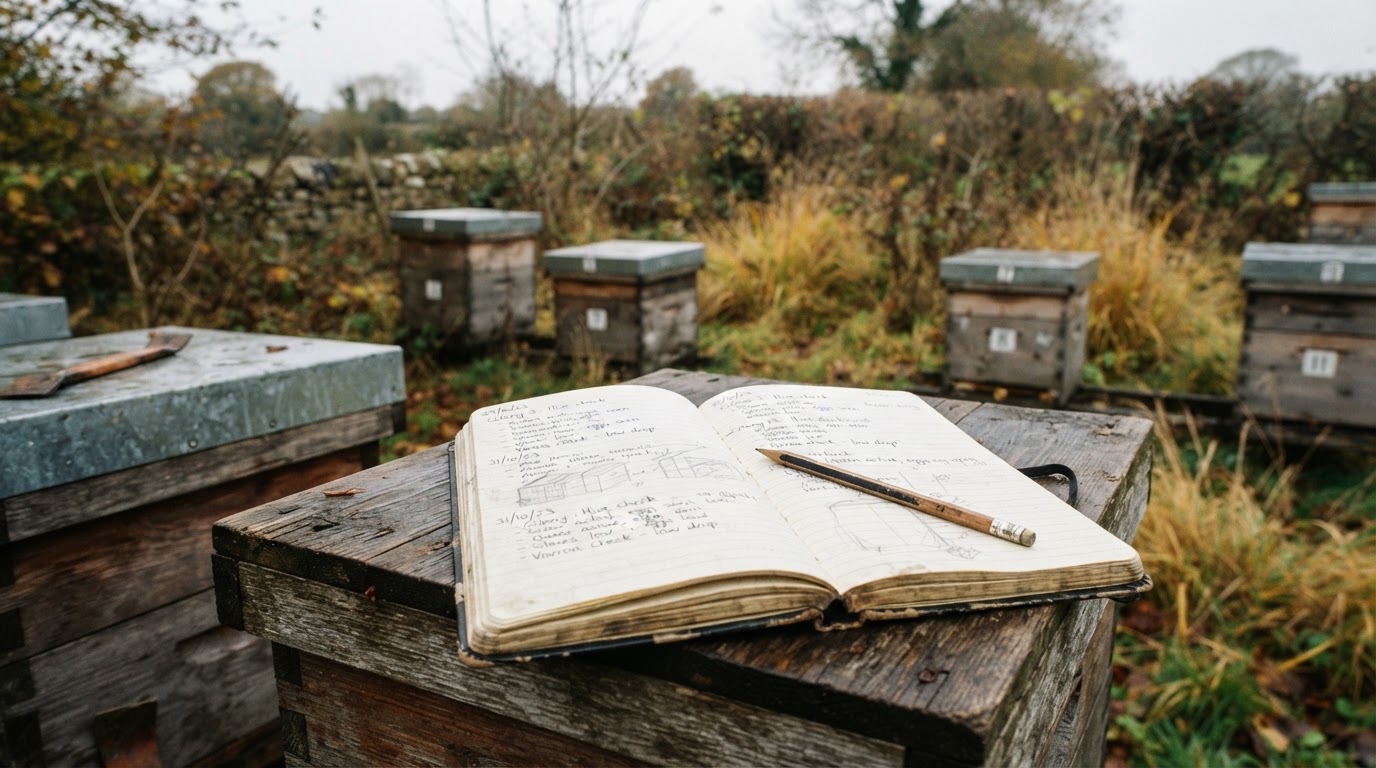
Responsible bee improvement begins with observation, not a favourite colony or a single impressive inspection. A hive may look strong in spring, produce a good crop or appear calm on one day, yet those snapshots rarely tell the whole story. If we want locally adapted, resilient honey bees, we need records that describe performance across the season and place health—including Varroa management—at the centre of selection.
This guide offers a practical colony-selection scorecard for UK beekeepers. It is a record-keeping framework, not a scientifically validated ranking system. Use it to compare colonies consistently, identify promising queens and make better breeding decisions over several seasons.

Why a season-long record is better than a single inspection
Honey bee colonies are affected by queen age, weather, forage, apiary location, colony size, management, disease and the timing of inspections. A colony that is calm on a warm day with a strong nectar flow may behave differently during a poor-weather period or when its queen is failing. A colony with a large spring population may have benefited from a different winter, feeding history or forage opportunity than its neighbours.
Repeated observations help separate a pattern from an isolated event. BIBBA’s practical colony-record system, for example, considers traits such as temperament, brood and health, swarming propensity, overwintering and relative honey yield. Those are useful categories for a beekeeper to adapt, but the exact scoring system is a practical choice—not a universal scientific standard.
For a wider breeding context, see our guide to the drone side of sustainable queen breeding and our article on locally adapted bees in Britain.
Build a record that follows each colony
Give every hive a permanent identifier and record the queen’s origin and year where known. If a queen is replaced, note the change: performance observed under one queen should not automatically be attributed to her successor. Keep records with the colony rather than relying on memory or a notebook entry that cannot be matched to the hive.
At minimum, record:
- Apiary, hive number and hive type.
- Queen year, origin and replacement date, if known.
- Inspection date and conditions that could affect observations.
- Colony strength and brood area, using a consistent method.
- Temperament and ease of handling.
- Brood pattern, visible disease signs and any action taken.
- Varroa monitoring method, result, date and interpretation.
- Varroa treatment used, date, duration and follow-up result.
- Swarming events, management and queen outcomes.
- Honey yield and feeding, recorded in consistent units.
- Winter survival and spring condition.

A practical colony selection scorecard
Use a simple 1–5 rating if it helps you record observations quickly, but write the evidence beside the score. Do not add the scores into a single total and treat it as a scientific breeding value. These ratings are a beekeeper’s working notes, and they become more useful when repeated and compared over time.
1. Temperament and manageability
Record how the colony behaves during routine inspections: calmness on the comb, tendency to run, defensive response and how easily it can be managed. Avoid judging from one inspection. Weather, nectar availability, queen status, robbing pressure and handling can all affect behaviour. Record the context and look for a consistent pattern across several visits.
Good temperament is a practical and safety-related breeding objective, particularly where apiaries are close to neighbours, footpaths or public areas. It should not be sacrificed simply because another colony produces a larger crop.
2. Brood pattern and colony health
Record the amount of brood, its pattern and any visible signs of disease or abnormal development. A brood pattern can be affected by queen age, nutrition, brood diseases and other factors; it is not a stand-alone test of hygienic behaviour or Varroa resistance. Describe what you actually see, rather than making a resistance claim from appearance alone.
If you suspect a notifiable disease, follow official UK reporting and inspection guidance. Breeding decisions must not take priority over disease control.

3. Spring development and overwintering
At the first suitable spring inspection, compare each colony with the apiary’s own baseline. Record survival, relative strength, food reserves, brood development and any unusual signs. The comparison is more meaningful than an arbitrary expectation that every colony should reach a particular size on a particular date.
Survival is important, but survival alone does not establish resistance. A colony may have survived because it received effective treatment, had a favourable microclimate, was well provisioned or experienced lower mite pressure. Record those circumstances so that performance is interpreted fairly.
4. Swarming tendency and management
Record swarm preparations, swarm events, queen cells and the management used. Swarming is a natural reproductive behaviour; the score is about how the colony’s behaviour fits your management objectives and whether it remains healthy and productive. A colony that swarms is not automatically genetically inferior, and careful swarm control should not be confused with selection for a trait.
5. Honey yield and resource use
Record the honey harvested from each colony in consistent units, and compare it with the apiary average where possible. Relative yield can be more informative than absolute yield when colonies face different local conditions. Also record feeding and any management that affected the result. A large crop should not outweigh poor health, unmanageable temperament or a concerning Varroa record.
6. Varroa monitoring and treatment history
This is essential when selecting for resilience. Record the monitoring method, date, result, brood context, treatment used and follow-up assessment. Monitoring methods are not interchangeable, so compare like with like and interpret results using the guidance for the method you used.
Use monitoring to inform timely intervention. The National Bee Unit’s integrated pest management guidance explains that controls should be matched to infestation risk and that high mite levels require effective action. Use authorised medicines according to their product information. A colony should not be left heavily infested or untreated simply to see whether it survives, and a colony’s weakness alone is not a reason to make a treatment decision.

What evidence is useful when selecting for Varroa resistance?
Varroa resistance and tolerance are complex traits. Research in the UK has identified behaviours and outcomes that may contribute to resistance, including targeted recapping and reduced mite reproductive success. Those findings are promising, but they do not mean that ordinary visual inspection can identify a resistant colony reliably.
Where practical and supported by training or a recognised protocol, beekeepers can assess hygienic behaviour or other measurable traits. Repeat tests, record the method, and avoid claiming resistance from a single result. If you are not using a standardised test, label your observation as an observation—for example, ‘some recapping noticed’—rather than as a confirmed resistance trait.
Recent selection research demonstrates that deliberate selection for lower Varroa population growth can improve health outcomes under study conditions. Such findings support breeding as part of long-term improvement, not the abandonment of routine monitoring and treatment. The results of any study must be interpreted in the context of its stock, methods and environment.
How to compare colonies without fooling yourself
- Compare within a similar setting: apiary location, forage, hive type and management can influence results.
- Record queen changes: do not attribute a daughter’s performance automatically to the previous queen.
- Look across more than one season: one good year is encouraging, but not conclusive.
- Keep intervention records: treatment, feeding and swarm management affect outcomes.
- Use measured traits where possible: separate formal test results from casual observations.
- Keep genetic diversity in mind: avoid repeatedly breeding from a single queen without considering relatedness, mating and the wider population.
- Do not select solely for survival: health, manageability, productivity, treatment history and measured mite-related traits all contribute to a balanced assessment.
When should you choose breeder colonies?
Late autumn and winter are good times to review the season’s records and create a shortlist, but the final decision should wait for a suitable spring assessment. A promising colony may change over winter. Assess it when the weather and colony condition permit, and make sure it is healthy and sufficiently strong before encouraging drone production or raising queens.
For open-mated queens, remember that you cannot control all paternal genetics. Selection is a gradual population-level process. Working with local beekeepers, sharing observations and maintaining healthy colonies can help create a more consistent local mating population over time. It is not a guarantee of controlled parentage.
Evidence, practical recommendations and opinion
Evidence: research supports the potential to improve some hygienic and Varroa-related traits through selection. Studies also show that resistance mechanisms are varied and that results depend on methods, genetic stock and conditions.
Practical recommendation: maintain consistent records, monitor Varroa, intervene when indicated, use authorised treatments correctly and compare colonies fairly. Consider breeding from colonies with repeated, documented performance across several traits.
Opinion: a simple, consistent record card is better for most small UK apiaries than an elaborate score that is rarely completed. The goal is to make decisions more thoughtful—not to create false precision.
A practical takeaway for this winter
Before spring, create a shortlist of potential breeder colonies using last season’s records. Keep the shortlist provisional. At the first suitable inspection, reassess winter survival, brood, health and temperament. Review the Varroa record and treatment history, and only advance colonies that meet your health and management standards. Use measured resistance traits where possible, and continue normal monitoring and intervention for every colony.
For further guidance, consult:
- BIBBA’s Queen Rearing Guide and colony record card—a practical framework for assessing several traits.
- How BIBBA selects breeder queens—an example of season-long selection.
- National Bee Unit: Using integrated pest management for Varroa control.
- UK research on recapping behaviour and reduced Varroa reproduction in naturally resistant colonies.
- Research on selecting honey bee genotypes for lower Varroa population growth.
Good breeding decisions are built from careful observation, honest records and responsible management. A resilient local bee population is a long-term goal; sound Varroa control and colony welfare remain the priorities today.