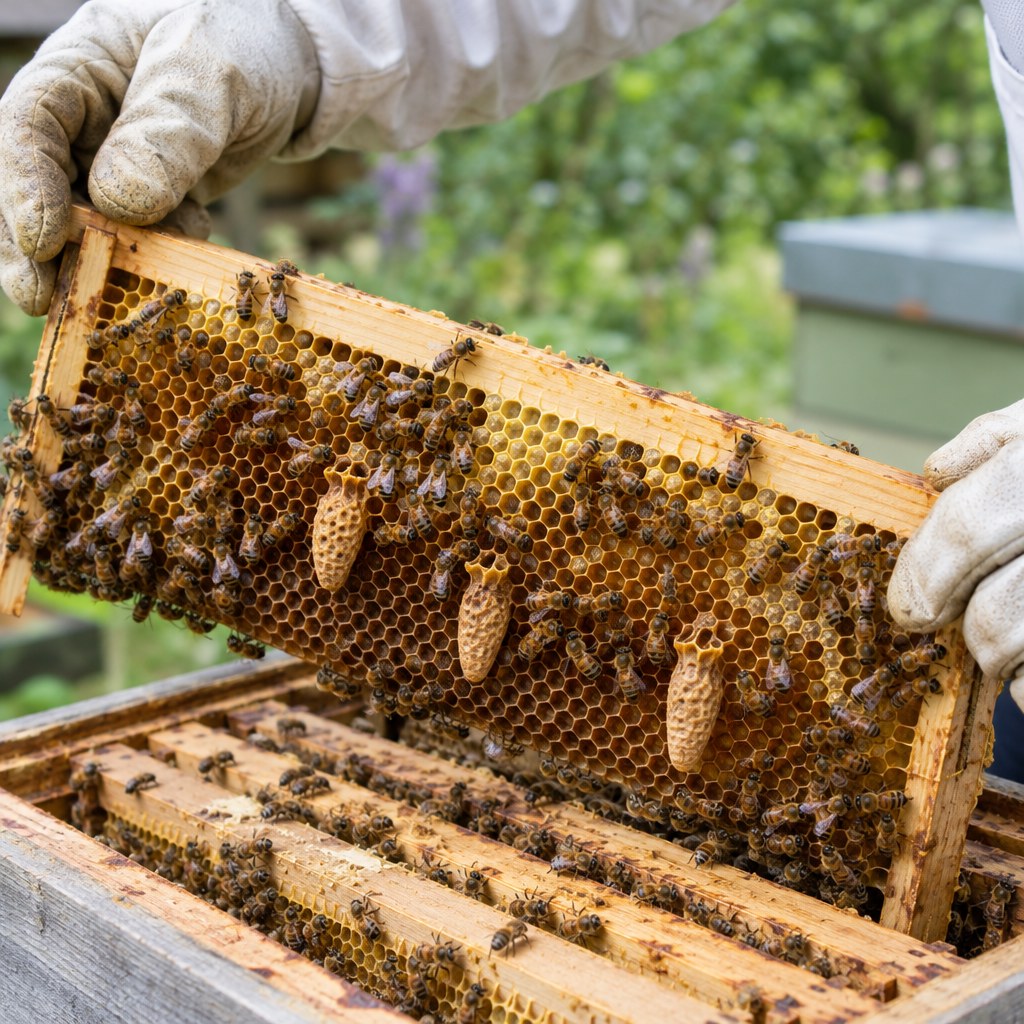
Finding Queen Cells: What It Means for Your Colony
Finding queen cells during a hive inspection can be worrying, particularly for newer UK beekeepers. Queen cells are a normal part of honey bee biology, but their presence can indicate that a colony is preparing to swarm, replacing a failing queen, or responding to another change within the hive.
The important thing is not to panic or destroy every queen cell automatically. Take time to assess the colony, the brood pattern, the season and the type and location of the cells.
Why honey bees make queen cells
Colonies make queen cells for several main reasons:
- Swarm preparation: a strong colony may prepare to reproduce by sending a swarm away with the old queen.
- Supersedure: workers may replace a queen whose performance or condition has declined.
- Emergency queen rearing: if the colony suddenly becomes queenless, workers may raise queens from suitable young larvae.
How to distinguish the situations
Queen-cell appearance and placement can offer clues, but they are not definitive on their own. Swarm cells are often found along the lower edges of comb or in groups, while supersedure cells may be fewer and positioned more centrally. Emergency cells may be built out from worker brood cells and can appear in various places across the comb.
Look at the whole colony: eggs and young larvae, the queen if seen, brood pattern, congestion, colony strength and recent management history. A single observation is rarely enough to make a confident decision.
What to do during the inspection
- Stay calm and inspect carefully. Avoid rushing or making a destructive decision.
- Check for eggs and young larvae. These help establish whether the colony is queenright and whether a queen has been laying recently.
- Assess congestion. Check whether the brood nest is crowded and whether the colony has sufficient space appropriate to its strength and the season.
- Record what you find. Note the number and position of cells, brood condition, queen status and your actions.
- Choose a management plan. If swarm preparation is likely, use a method you understand and can carry out properly, taking account of colony strength, queen status and local conditions.
Should you destroy queen cells?
Removing queen cells without addressing the colony’s underlying condition is often ineffective. If the colony is preparing to swarm, simply knocking down cells may delay the process rather than prevent it. Cells may be rebuilt, and the colony can still swarm.
Make a deliberate management decision based on the situation. If you are inexperienced or unsure, seek practical advice from a local association mentor before undertaking a complicated manipulation. Our UK swarm-management guide explains the broader planning considerations, while the guide to making nucleus colonies covers another option for managing colony growth when conditions and your experience allow.
Keep a record of queen-cell inspections
Accurate records help you recognise patterns and make better decisions. Record the date, colony identification, queen status, brood observations, number and location of queen cells, congestion, weather and any management performed. Revisit the notes at the next inspection.
Free resources for UK beekeepers
Our Free Beekeeping Guides library includes practical resources for hive inspections, swarm preparation, queen and brood checks, Varroa monitoring and seasonal management.
You may also find these articles useful:
For a broader assessment of queen status, read How to Tell Whether a Honey Bee Colony Is Queenright.
- A Simple, Methodical Hive Inspection Routine
- The Complete UK Beekeeping Calendar: Month-by-Month Guide
Queen-cell assessment checklist
- Record the number and location of cells you observe.
- Check for eggs, young larvae and brood condition.
- Assess colony strength and congestion.
- Consider recent swarming, queen loss or management history.
- Identify a suitable management plan before acting.
- Record the decision and schedule any necessary follow-up.
Frequently asked questions
Should I always remove queen cells?
No. Removing cells without addressing the reason they were raised may be ineffective. Assess the colony and choose a suitable management approach.
Can I tell the reason for queen cells from their position alone?
Position and appearance can offer clues but are not definitive. Consider brood, queen status, colony strength, season and history together.
What if I am unsure what to do?
Avoid rushed or complicated interventions. Ask an experienced local beekeeper or association mentor for practical guidance.
Final reminder
Queen cells are information, not automatically a problem. Assess the colony as a whole, understand why the cells may have been raised, make a considered management decision and record what you did. A calm, systematic approach is more useful than reacting to the cells alone.